
What Would Don Draper Do?

AI, advertising, and the enduring power of human truth
In 1960, a man stood in a darkened conference room, a carousel of family photographs rotating slowly on the wall in front of him, and delivered one of the most quietly devastating pitches in the history of popular culture. The product was a Kodak slide projector. The pitch could have been about features, about engineering, about value for money. Instead, Don Draper talked about nostalgia, what he called “a twinge in your heart, far more powerful than memory alone.” He called the machine a time machine. He made a roomful of executives feel something they hadn’t expected to feel in a product meeting, and by the time he was finished, nobody was talking about the projector.¹
It is a fictional scene, of course. But it distills a truth about advertising that predates Mad Men, predates Madison Avenue, and will outlast whatever comes next. The most powerful thing you can do for a brand is make the people who encounter it feel something real. Not impressed. Or informed. Moved.
We are living through the most significant disruption the advertising and creative industries have experienced since the internet and the personal computer rewired the business in the 1980s and 90s. The tools, processes, teams and economics have changed beyond recognition. And yet the fundamental ask— make someone feel something true about this brand—remains the same. So what would the man who appeared to understand that better than most do with the emergence of AI? And what becomes of the people whose entire careers are built on that same, irreducibly human skill?
First, there was the word
Before there were creative teams and brand strategists, before there were integrated campaigns running across seventeen channels simultaneously, advertising was a writer’s discipline. A headline or a claim. A sentence that made someone stop on the page and feel the pull of wanting something.
Copy was king, and language was the engine . But it needed the arrival of admen, like Draper, to take it from literal descriptor to emotional idea.
This is the sequence that has never changed, regardless of era or medium: idea in the brain, language in the room, story in the boardroom, ad in the world. Before an audience ever sees a thing, someone has to sell it in words to the people who will pay to make it real. The adman has always been part storyteller, part salesman. The pitch preceded the execution. The language came first.
In the early days of advertising, and Mad Men, though, that language stayed siloed. The copywriter wrote the words. The art director made them look presentable. The two rarely met. The copy arrived, sometimes literally slid under a door, and it was someone else’s job to make it look pretty. The resulting work was, as you might imagine, largely forgettable, aside from the likes of David Ogilvy & Draper Daniels of Leo Burnett, pioneer admen on whom Don Draper was modeled.
Then a man named Bernbach had a different idea about ideas.
Bill’s big idea about big ideas
Bill Bernbach opened Doyle Dane Bernbach with a founding conviction that was radical enough to reshape the entire industry: that the best advertising happened when a copywriter and an art director were put in the same room, treated as equals, and left to build something together that neither could reach alone.²
This sounds obvious now. It wasn’t then. What Bernbach understood was that the idea existed in the collision between disciplines, in the space where verbal and visual instinct pushed against each other until something better emerged. He put copywriters and art directors together because he believed the resultant idea was king.
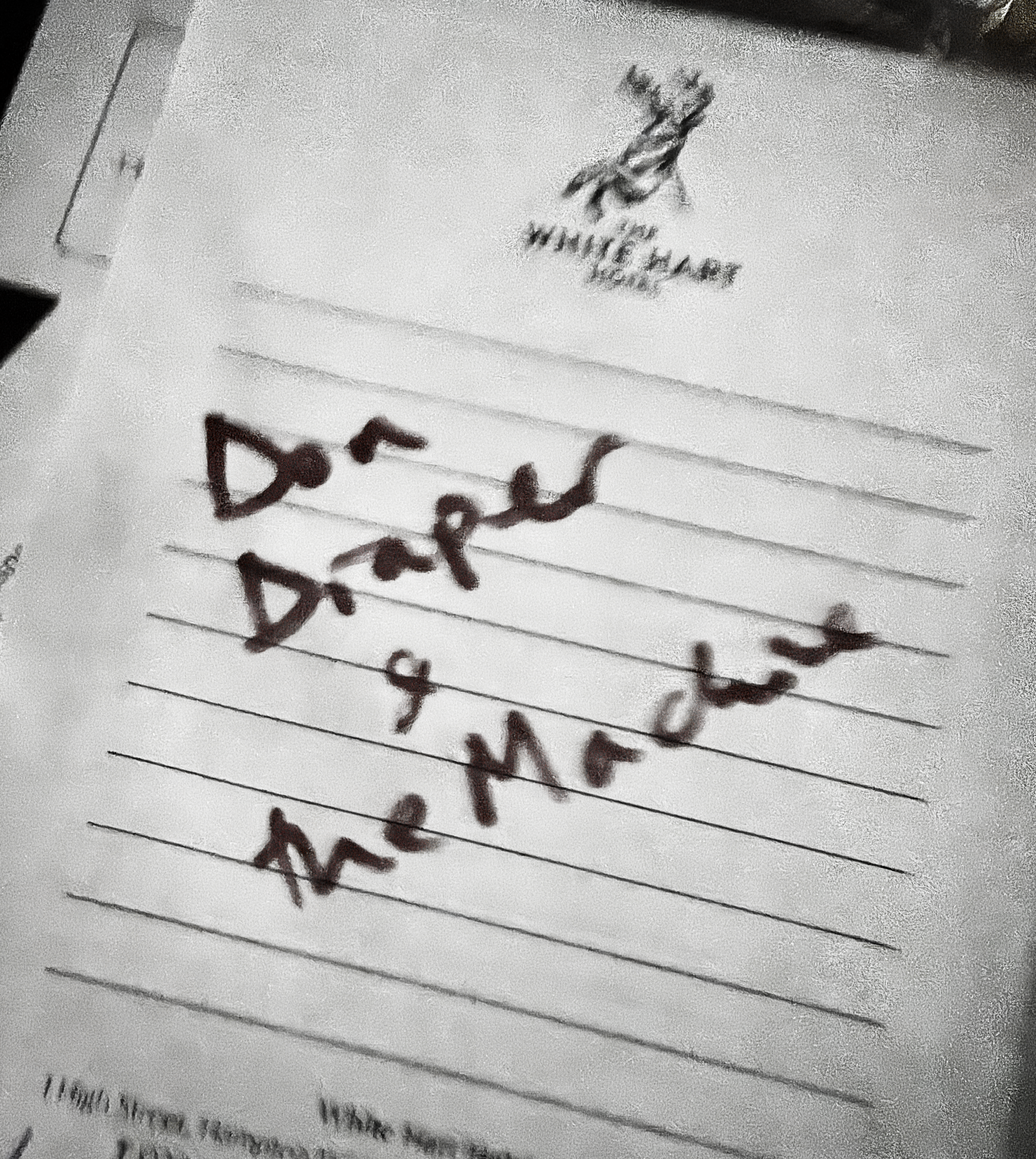
Where this started. White Hart Hotel. Post-shower. During coffee.
Bernbach never valued the copywriter above the art director, or vice versa. The art director’s contribution was never purely aesthetic. It was the accumulated instinct that knows when something feels right before you can explain why. The ability to look at a half-formed idea and sense its potential, or its failure, without a single word of explanation. That is not a production skill. Bernbach understood that, and built his agency around it.
The work they produced (Think Small for Volkswagen, We Try Harder for Avis) wasn’t great because of a process. It was great because two people with genuine trust in each other refused to stop until the idea was right. Visuals began taking more creative license, but language still stood as the foundation of those ideas, and created campaigns that entered the culture and never quite left.
Some of the greatest advertising ever made contains almost no words at all. A wordless Lego campaign, a perfectly framed Heinz visual—these are not failures of language. Because the decision to say almost nothing is still a language-based judgment. That creative call began as a sentence in someone’s head, in a room where two people said what if we trusted the image to do everything? You cannot arrive at that decision without first being able to articulate what the idea needs to make people feel.
I spent the better part of thirty years in that model. The best partnerships I experienced had no silos, no hierarchy of disciplines, no sense that the word or the image belonged to one person more than the other. A copywriter who thought visually. An art director who thought in headlines. The idea was the only thing in the room that mattered, and both of us were entirely in its service. That’s the gold dust Bernbach found, and it didn’t tarnish for over half a century.
Which is why what’s happening now is worth naming clearly: AI didn’t kill that model. It removed the org chart that housed it.
Madison Avenue and the myth of the lone genius
The Don Drapers of the sixties and seventies operated in a world where the creative director was the oracle. The person who swept into the pitch at the eleventh hour with the answer. Who could feel the idea, find the language, build the story, make the room believe it before a single frame was shot . And make it look like fact rather than subjectivity.
That mythology has truth in it. The great campaigns of that era were born from people who understood people and found a way to crystallize it into something simple enough to be remembered and powerful enough to last. Don Draper was the fictional archetype of that ability, his genius rooted in one thing: he paid attention to what people actually felt, not what they said they felt. It was honesty laid bare.
But honesty requires accountability. That era operated without accountability in a way that is simply not available to anyone working today. No real-time performance data. No client asking why the campaign under-indexed on mobile. The idea was judged on how it landed in the room, not what it did in the market, though product sales were always the ultimate verdict. They simply arrived months later, without the real-time scrutiny that defines every campaign today.
What that era got permanently right, though, and what no amount of technological disruption has managed to invalidate, was the belief that advertising’s primary job was to create a feeling in an audience. Happiness. Aspiration. Belonging. That warm ache of nostalgia. Sell the emotion, and a memorable brand follows.
Data. The perceived grown-up in the room.
The decades between Bernbach and the present were shaped by a progressive shift in who held the power in the client-agency relationship, and who was accountable for the spend.
Television scaled the big idea and made it culture. Digital fragmented it into thousands of targeted messages and gave the industry an entirely new language (clicks, impressions, conversion rates) that made accountability not just possible but mandatory. For the first time, advertising could be measured with the kind of precision that made intuition harder to defend.
And something important happened in that shift. Data became the dominant language of justification. If you couldn’t measure it, you couldn’t easily argue for it. The result was an industry that drifted, in the words of Sir John Hegarty, into something he named with characteristic precision:
“We’ve drifted into a kind of collective sleepwalk, seduced by the certainty of data and the supposed safety of algorithms. We call it optimisation, but in truth it’s just doing the same thing as everyone else, only slightly faster.
It feels productive and intelligent, but it’s also incredibly dull.
I call this the Boredom Tax.”
- Sir John Hegarty³
The channels became the conversation. The idea became harder to find in them.
Meanwhile, the internet, social media, iPhones and their apps quietly began something that AI would later complete: the democratization of visual production. Instagram, Canva, the template economy etc. Design tools that put a version of creative capability in every hand. Everyone became a marketing creative. Production, at a functional level, stopped being a specialist skill. Long before generative AI arrived, the walls around craft and execution were already coming down.
A different kind of truth
Generative AI did something no previous technology had managed: it collapsed the distance between imagining something and making it real.
And the disruption this has created is not simply about two job titles. The creative industry ran on an entire ecosystem of talent. Writers, art directors, illustrators, UX designers, content strategists, retouchers, photographers, production artists, directors, crew etc. People who built careers on genuine craft, on accumulated excellence. The layoffs we are witnessing are not an abstraction. They are talented people whose skills are being commoditized by tools that can approximate their output at a fraction of the cost and in a fraction of the time. The industry owes that reality an honest acknowledgment, not a pivot.
What AI democratized is execution, not judgment.
The ability to make something has never been more accessible. A single person with the right tools can now generate what once moved through an entire production line. That is genuinely remarkable, and the industry would be foolish to pretend otherwise.
The history of advertising is also full of people who were early to the medium and thin on the judgment to use it well. Technology without insight has always been noise at scale. That was true when television arrived. It is no less true now.
So the ability to know when something resonates, or when the feeling is slightly off, is rarer now than it has ever been. Because now everyone can make something. But not everyone knows the difference between something that functions and something that truly stands out. And far fewer people can make something worth feeling.
It was always about the words
And here is where the arc closes, returning not to the agency model that shaped the industry, but to the very thing that preceded it: language itself.
We have returned to the primacy of the written word, but with a more consequential impact than the copywriter-as-king era ever had. Because now the quality of your thinking is inseparable from your ability to articulate it. You cannot show AI a feeling. You have to describe it. The clarity, the precision, the emotional intelligence of what you put in determines entirely the quality of what comes out.
This is not a minor operational point. It is a profound creative one. The prompt is not the new headline—the headline is still a judgment call, a taste decision, a human instinct that no tool manufactures. But the prompt can be the fuel that makes the headline possible. And what separates a remarkable prompt from a generic one is exactly what has always separated remarkable advertising from generic advertising: a person who knows what they want another human to feel before they decide what they want them to see.
That person does not have to be a copywriter. But they do have to be someone who has developed, through experience and genuine curiosity about people, the ability to find the human truth inside a brief and articulate it with precision. The art director with twenty years of visual instinct writes better prompts than the person who only knows the tools. The brand strategist who understands what a company truly stands for will out-prompt the person who is optimizing for output volume.⁴
The full circle has closed. Language was always the engine. The prompt just made that truth impossible to ignore.
Draper and AI — could they co-exist?
It is a reasonable question, and it deserves a balanced answer.
The case that they could
His entire method was rooted in human truth, not the medium he worked in : understanding desire, fear, aspiration, and memory at a level no data set can manufacture alone. The medium was print, then television. And he adapted. His loyalty was always to the idea, never to the channel.
The version of Draper with access to today’s tools is not a man constrained by a machine. It is a man with a million-mile view of the market—consumer behavior mapped at scale, competitive landscapes visible at a glance—feeding the instincts he always had. His intuition was powerful in a room with one client and a cigarette. Imagine it backed by data that confirms, deepens, and challenges his read of what an audience needs to feel. Intuition and insight. Draper on steroids.
But the most compelling argument for Draper in the AI era isn’t his instinct alone. It’s his ability to articulate. That precise, almost surgical gift for finding the language that unlocks a feeling in another person is exactly what the machine needs from the human behind it.
The case that they couldn’t
It centers on the one place his model genuinely fails in 2026: accountability. Real-time performance data is not compatible with “trust me, this is right” as a complete answer. The modern client relationship demands transparency of process and a willingness to be wrong in public. His ego and his resistance to change were, in the end, two expressions of the same liability, and the IBM computer arriving at Sterling Cooper remains one of the most honest moments in the series. A man of extraordinary instinct, confronted by a tool he couldn’t charm or outthink, choosing rejection over curiosity. That choice, in the current landscape, would cost him.⁵
But none of these are failures of intelligence or instinct. They are failures of adaptation. And the history of advertising is full of people who adapted when the stakes were high enough. Today the AI disruption is seismic. For an entire generation of creative talent, the questions it raises are existential. And people are looking for answers.
The final scene of Mad Men makes the case better than any analysis can: Don Draper, sitting on a clifftop meditation retreat, something shifting in him. And then the Coca-Cola Hilltop ad. An advertisement still remembered for how it made people feel. He found it by going deeper into people, not further away from them.⁶
Mighty humans
Process changes, human truth doesn’t
In that Kodak presentation, what Draper found wasn’t a product truth. It was an irreducible human one, the need to hold onto who you were, to return to moments where you knew you were loved. No algorithm surfaces that. A person does. A person paying deep attention to what other people feel.
What advertising has always needed, in every era, across every medium and every technological wave, is precisely that: someone who understands what another person needs to feel. AI does not change that requirement. It amplifies the value of the person who meets it.
The tools are extraordinary. But they are only as powerful as the clarity, the empathy, and the judgment of the person behind the prompt. And right now, across this industry, there is an entire generation of creative talent, people who built careers on exactly those qualities, who understand brands, their audiences and the alchemy of an idea that lands, navigating a disruption that has moved faster than any transition the industry has previously managed.
The question that needs answering honestly is not whether AI will change the game. It has. It is how the hard-won human judgment that built this industry finds its footing in this new ecosystem. How we upskill and reconnect around what people do that tools cannot replicate. How we ensure that the democratization of execution becomes an amplifier of human potential, not a replacement for it.
That is the conversation Mighty Humans was built to have. A community and a mission grounded in the belief that the era of AI is not a ceiling on what people can do—it is the clearest argument for human potential the industry has ever produced. That the people who thrive will be those who use these tools to extend what only humans can: connect, resonate, and move people toward something true.
“First, there was the word. After all of it, the art, the media, the data, the platforms, the algorithms, the prompts, the machines, there is still only the word. But the word has to come from somewhere: from taste, judgment, empathy, and a human being paying attention. That is the bridge between human truth and machine execution.”
- Grant McDougall, Founder of Mighty Humans⁷
WWDDD?Don Draper’s answer, in that darkened room with the carousel turning, was to find the feeling no machine could manufacture, and make people believe in it.
That answer hasn’t changed.
______________________
Mighty Humans is going to Cannes Lions International Festival of Creativity 2026 to unveil news on how you can unlock your true potential!
Daryn Henry is a creative director with thirty years in marketing and advertising, an ambassador for Mighty Humans, and is studying Appllied Agentic AI for Organizational Transformation with MIT Professional Education.
______________________
References
¹ Matthew Weiner (creator), Mad Men, Season 1, Episode 13, “The Wheel.” AMC, 2007.
² Luke Sullivan, Hey Whipple, Squeeze This: The Classic Guide to Creating Great Ads. Wiley, 5th edition, 2019.
³ Sir John Hegarty, “The Boredom Tax.” LinkedIn. https://www.linkedin.com/pulse/boredom-tax-sir-john-hegarty-sxzqe/
⁴ Ethan Mollick, “Working with AI: Two paths to prompting.” One Useful Thing, Substack. November 1, 2023. https://www.oneusefulthing.org/p/working-with-ai-two-paths-to-prompting
⁵ Matthew Weiner (creator), Mad Men, Season 7, Episode 4, “The Monolith.” AMC, 2014.
⁶ Matthew Weiner (creator), Mad Men, Season 7, Episode 14, “Person to Person.” AMC, 2015.
⁷ Grant McDougall. May 9, 2026.